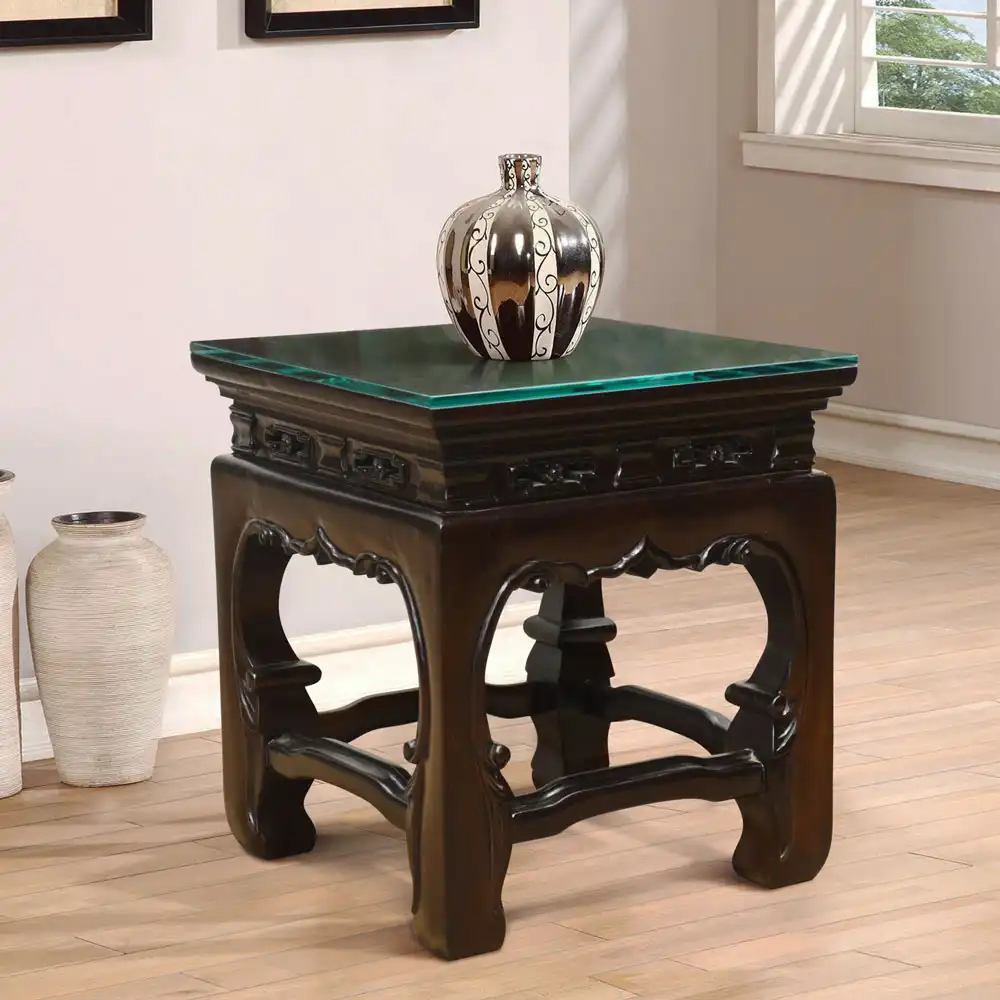
The Kanagawa end table is a freestanding occasional furniture piece constructed entirely from solid teak wood. Teak is a dense tropical hardwood recognized for its high natural oil content, which provides inherent resistance to moisture, decay, and insect damage. The material exhibits a characteristic grain pattern with variations ranging from golden brown to deeper honey tones, dependent on individual timber variation and finishing processes.
With a width of 42.00 centimeters, a depth of 42.00 centimeters, and a height of 46.00 centimeters, the table occupies a square footprint designed for placement beside seating arrangements such as sofas, armchairs, or beds. The total physical weight of the unit is 11.00 kilograms, providing enough mass to prevent accidental shifting during routine daily use while remaining light enough to be repositioned manually across interior floor surfaces. The packaged volume of the item measures 0.0800 cubic meters, a metric relevant for freight calculation, spatial planning during transit, and warehousing logistics.
The structural assembly relies on traditional joinery methods integrated into the solid teak framework. The top surface forms a square plane measuring 42 by 42 centimeters, offering a flat platform intended for holding small accessories, lighting fixtures, reading materials, or beverage containers. The thickness of the tabletop timber is dimensioned to support localized loads without deflection. Supporting the tabletop are four vertical legs positioned at the extreme corners of the square base, ensuring stability across flat flooring surfaces. The connection points between the legs and the underside of the table incorporate reinforced joints to withstand lateral forces.
The surface finish of the Kanagawa end table is sanded smooth to the touch while preserving the tactile qualities of the underlying wood grain. No synthetic laminates or wood veneers are used in the construction; the visible surfaces consist entirely of solid teak planks. Maintenance requirements for this material specification typically involve periodic wiping with a dry or slightly damp cloth to remove dust and debris. Because teak reacts to prolonged exposure to direct ultraviolet light and humidity fluctuations, indoor placement is recommended to maintain the dimensional stability of the wood components.
The design language of the Kanagawa model adheres to minimalist principles, omitting extraneous ornamentation in favor of clean geometric lines and structural clarity. The 46-centimeter height places the tabletop at a functional level relative to standard low-profile seating, allowing users to reach items placed on the surface without excessive bending or stretching. The compact 42-by-42-centimeter dimensions allow the furniture piece to fit into narrow gaps between furniture groupings, small bedroom corners, or apartment layouts where floor space is limited.
Manufacturing tolerances are maintained to ensure uniformity across production batches, aligning with commercial and residential interior specifications. The underside of each leg includes flat contact points designed to rest evenly on hardwood, tile, or carpeted floors. Hardware components utilized in the internal construction are selected for corrosion resistance, ensuring long-term structural integrity. The combination of solid teak composition, balanced weight distribution, and precise dimensional proportions establishes the physical profile of the Kanagawa end table as a durable, functional utility item for daily domestic or hospitality environments.
| Product Info | |||||||||||
|---|---|---|---|---|---|---|---|---|---|---|---|
| Dimension |
| ||||||||||
| Material | Teak | ||||||||||