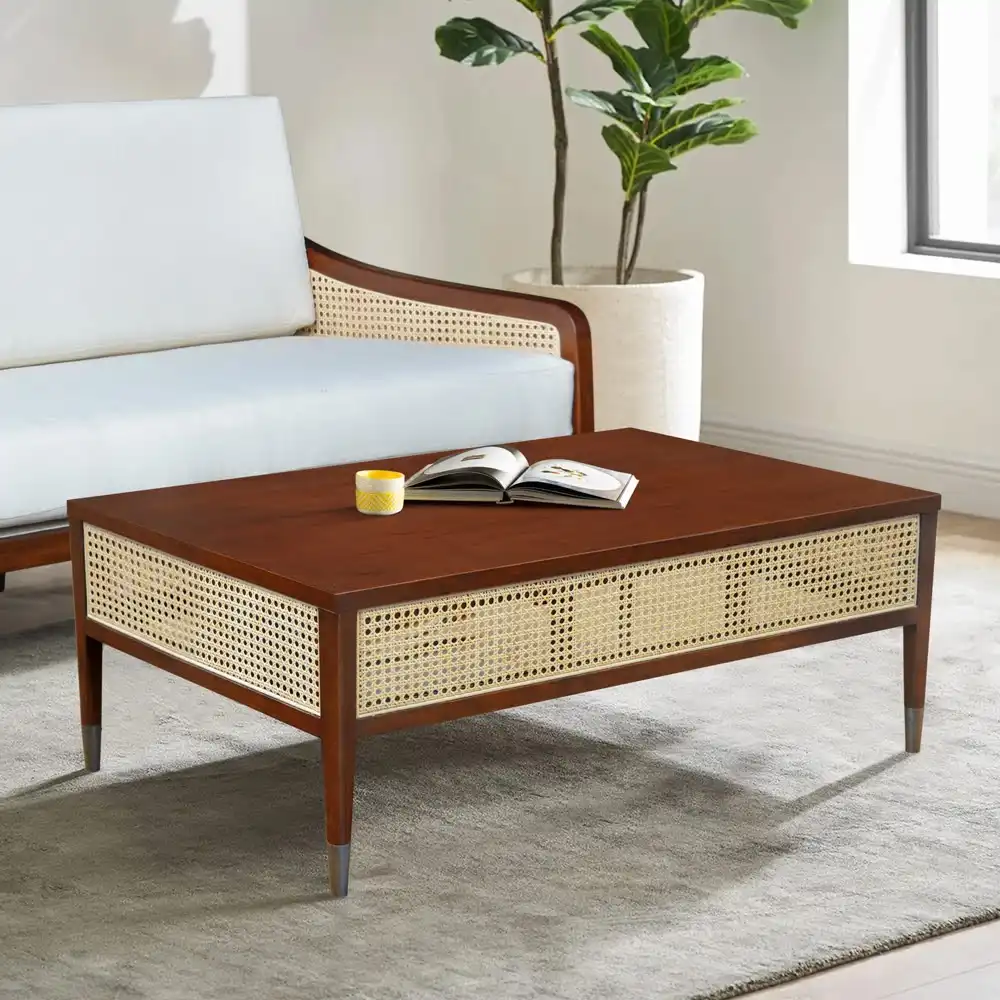
The Safari Coffee Table measures 120.00 cm in width, 80.00 cm in depth, and stands at a height of 45.00 cm. This low-profile rectangular footprint provides a substantial surface area for domestic or commercial seating arrangements, specifically proportioned to sit comfortably in front of standard three-seat sofas or sectional configurations. The entire physical structure is constructed from solid teak wood, a dense tropical hardwood known for its natural oil content and high tensile strength. Teak resists moisture absorption, warping, and splitting, making this furniture piece structurally stable across varying indoor humidity levels.
Weighing 36.00 kg, the table relies on its mass to remain firmly planted on flooring surfaces without sliding under normal daily use. The wood exhibits the characteristic tight grain and warm, golden-brown coloration inherent to mature teak. Artisans finish the raw timber surfaces by sanding them smooth to the touch while preserving the natural variations in the grain pattern and color tonality. No synthetic veneers, particle board, or secondary wood species are utilized in the core construction.
The tabletop dimensions of 120 cm by 80 cm create a usable surface plane of 0.96 square meters. This surface accommodates serving trays, books, decorative objects, and daily utility items concurrently. The 45 cm height positions the table at a level accessible from a seated posture, allowing users to reach items on the surface without excessive bending. The thickness of the teak planks used for the tabletop provides structural rigidity, preventing sagging or flexing when weighted objects are placed in the center.
Beneath the primary surface, the framework incorporates joinery techniques designed to connect the legs and the tabletop securely. The legs are integrated directly into the corners of the frame, distributing the 36 kg total weight evenly across four ground-contact points. This four-legged configuration prevents wobbling on flat floors and supports heavy loads placed on the tabletop without structural fatigue. The clearance beneath the apron of the table allows for easy cleaning underneath the unit using standard household vacuums or brooms.
With a volume displacement of 0.4320 cubic meters (CBM), the table occupies a defined spatial footprint that requires consideration during room layout planning. The volumetric mass reflects the heavy-duty use of solid timber components rather than hollow or lightweight manufactured boards. Teak requires minimal maintenance; routine cleaning involves wiping the surface with a dry or slightly damp cloth to remove dust and debris. Periodic application of natural teak oil can be performed by the owner to maintain the wood’s original saturation and prevent the gradual development of a silvery-grey patina caused by ultraviolet light exposure.
The Safari Coffee Table is shipped as a rigid, fully assembled unit, eliminating the requirement for mechanical fasteners, Allen wrenches, or on-site assembly procedures by the end user. The absence of moving parts, hinges, or drawers means there are no mechanical failure points that would require future maintenance or hardware tightening. The design adheres to a utilitarian rectilinear geometry, featuring right angles and clean edges that align with contemporary, transitional, or rustic interior schemes. The physical properties of the teak material ensure that the table withstands daily friction, accidental impacts, and the weight of heavy objects placed upon it over extended periods of continuous use.
| Product Info | |||||||||||
|---|---|---|---|---|---|---|---|---|---|---|---|
| Dimension |
| ||||||||||
| Material | Teak | ||||||||||