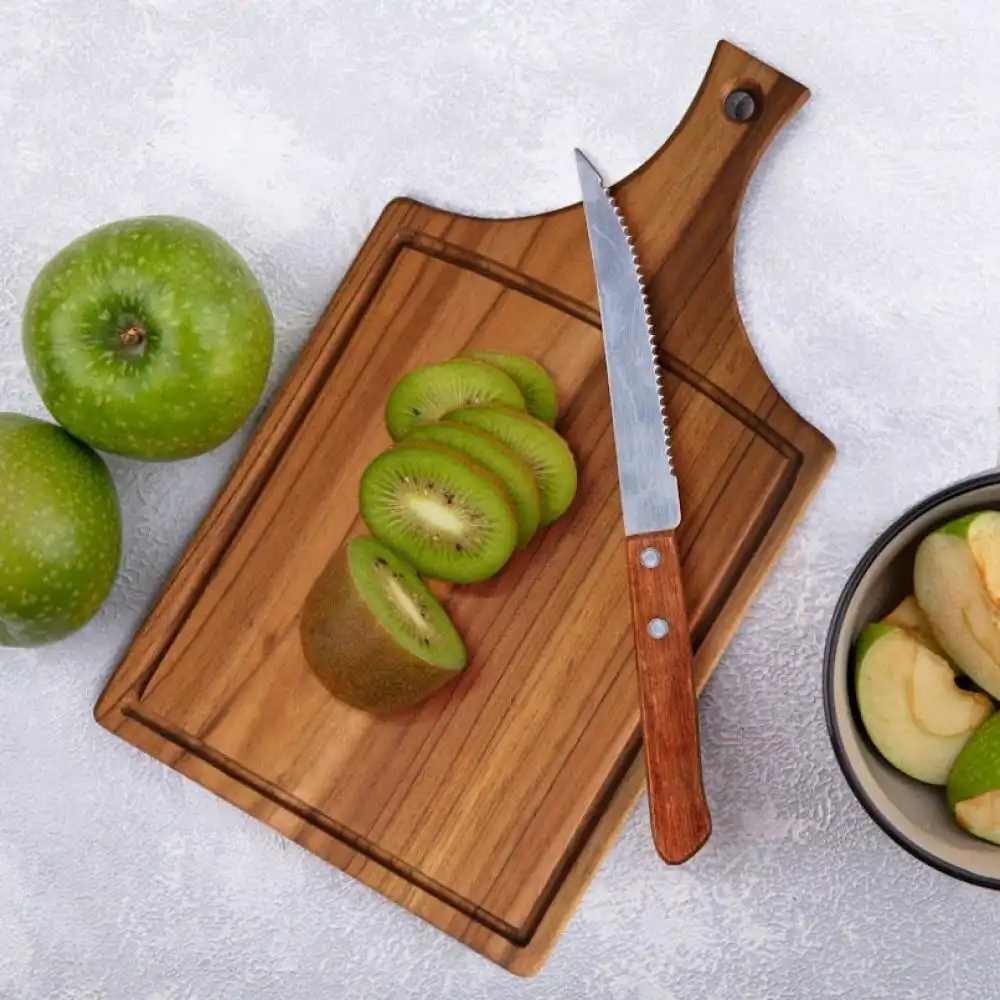
The Epaton Paddle Cutting Board is a solid teak utility surface measuring 38.00 centimeters in width, 22.00 centimeters in depth, and 2.00 centimeters in height. The entire object occupies a volume of 0.0020 cubic meters. Teak wood forms the core structural material of this board, chosen specifically for its natural density and high oil content. These inherent properties of teak provide a moisture-resistant barrier that limits water absorption during food preparation and washing. The grain pattern varies naturally across each individual board, dictated by the growth rings of the harvested timber.
The physical silhouette incorporates a distinct paddle configuration, consisting of a rectangular chopping zone and an integrated handle extending from one end. The rectangular body provides a flat surface area of 38 by 22 centimeters for slicing, dicing, and chopping ingredients. The handle component features an integrated hanging hole drilled through the terminal end, allowing the board to be suspended from a hook or peg when not in use. The 2.00-centimeter thickness provides structural rigidity, preventing the board from warping or flexing under downward pressure from heavy cleavers or chef knives.
All perimeter edges of the board are rounded and smoothed to eliminate sharp corners, ensuring a comfortable grip when lifting the board from a countertop. The surface undergoes a sanding process to create a uniform texture that is smooth to the touch while retaining enough friction to keep food items stable during cutting tasks. The natural golden-brown coloration of the teak wood shows grain variations ranging from straight lines to subtle whorls. Because teak contains natural rubber and oils, the surface resists the penetration of liquids and food odors more effectively than softer woods like pine or maple.
Maintenance procedures for the Epaton Paddle Cutting Board require hand washing with mild dish soap and warm water. Submerging the board in standing water or running it through an automatic dishwasher will compromise the structural integrity of the wood fibers and strip the natural oils. After washing, the board should be dried immediately with a towel and left to air dry completely in a vertical position. Periodic application of food-grade mineral oil or beeswax conditioner helps maintain the moisture barrier and prevents the wood from drying out or cracking over extended periods of use.
The density of the teak material measures high on the Janka hardness scale for woods utilized in kitchen applications. This characteristic means knife blades strike a firm yet forgiving surface that dulls edges less quickly than glass, stone, or hard plastic boards. Knife scars will accumulate on the surface through normal usage, which is standard behavior for wooden end-grain and edge-grain cutting implements. These surface marks can be addressed by light sanding with fine-grit sandpaper followed by a fresh coat of mineral oil.
Storage requirements involve placing the board in a dry environment with moderate humidity levels to prevent extreme expansion or contraction of the wood cells. Hanging the board by its handle utilizes vertical space in compact kitchen layouts, while horizontal storage requires a flat surface to maintain the 2.00-centimeter profile without lateral bending stress. The weight of the board remains manageable for single-handed transport from the prep station to the stove or serving table. The combination of solid teak construction, precise physical dimensions, and utility-driven design makes the Epaton Paddle Cutting Board a functional component for daily food preparation tasks in residential or commercial kitchens.
| Product Info | |||||||||||
|---|---|---|---|---|---|---|---|---|---|---|---|
| Dimension |
| ||||||||||
| Material | Teak | ||||||||||