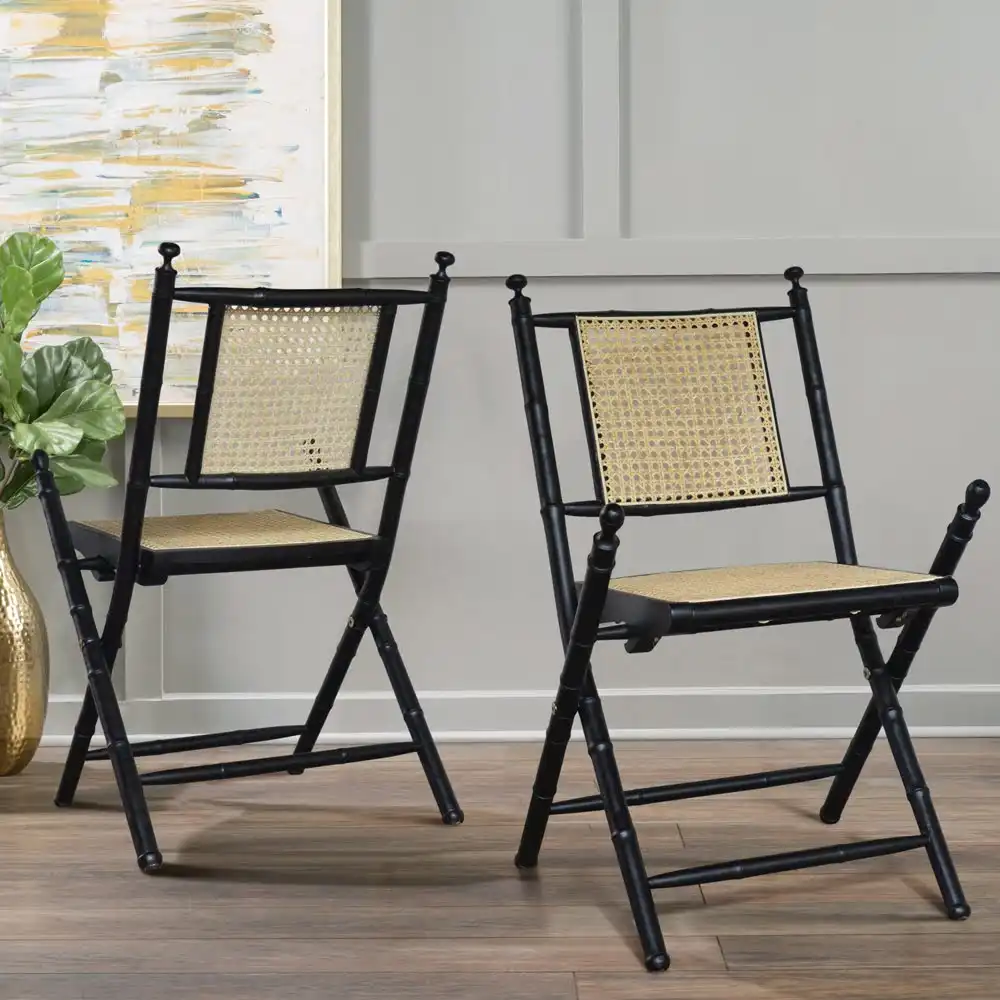
The Folding Chair with Arm is constructed entirely from solid teak wood, a dense hardwood harvested from sustainably managed plantations. Teak contains natural rubber and oil compounds that render the lumber resistant to moisture, rot, warping, and insect infestation without the need for synthetic sealants. The exposed grain features a straight, tight texture with a warm, golden-brown hue that responds to ultraviolet exposure by gradually developing a silvery-gray patina over time.
The primary structural framework utilizes solid teak members joined through mortise and tenon construction, secured with waterproof marine-grade adhesives. The backrest consists of three vertically oriented, curved wooden slats that conform to the natural curvature of the spine. The integrated armrests measure 5 centimeters in width and are fixed at a height of 65 centimeters from the floor, providing flat, continuous support surfaces for the forearms. Each armrest is anchored to both the rear upright post and the front leg assembly using stainless steel fasteners that sit flush with the wood surface.
The folding mechanism relies on a heavy-duty brass-plated steel pivot pin system located beneath the seat pan. When folded, the chair collapses flat to a depth of 15 centimeters, allowing multiple units to be stacked vertically or stored in narrow wall clearances. The seat platform is comprised of five horizontal teak slats spaced 1 centimeter apart to facilitate water drainage and air circulation. The front legs feature angled footings cut at a 15-degree pitch to ensure flat contact with the ground when the chair is fully deployed.
Regarding physical dimensions, the chair stands at an overall height of 90 centimeters, with a seat width of 52 centimeters and a total depth of 58 centimeters. The seat pan sits at a fixed height of 45 centimeters above ground level, accommodating standard dining table clearances. The total weight of the individual unit is 8.5 kilograms, balancing portability against structural stability during use. The rear legs extend upward to form the support structure for the backrest, while the front legs continue upward to intersect and support the armrests, creating a continuous load-bearing path from the top rail to the floor.
Surface preparation involves a multi-stage hand-sanding process that removes mill marks and leaves the teak smooth to the touch with a fine 220-grit finish. No chemical stains or pigmented paints are applied to the wood, preserving the authentic visual variation inherent in natural timber. Maintenance requirements consist of periodic washing with mild soap and water to remove surface debris. The inherent density of the teak material prevents liquids from penetrating deeply into the pores, minimizing staining from accidental spills. Outdoor storage during extended periods of freezing temperatures or heavy precipitation is recommended to extend the operational lifespan of the metal hardware components, although the wood itself withstands extreme weather variations without structural degradation.
| Product Info | |||||||||||
|---|---|---|---|---|---|---|---|---|---|---|---|
| Dimension |
| ||||||||||
| Material | Teak | ||||||||||