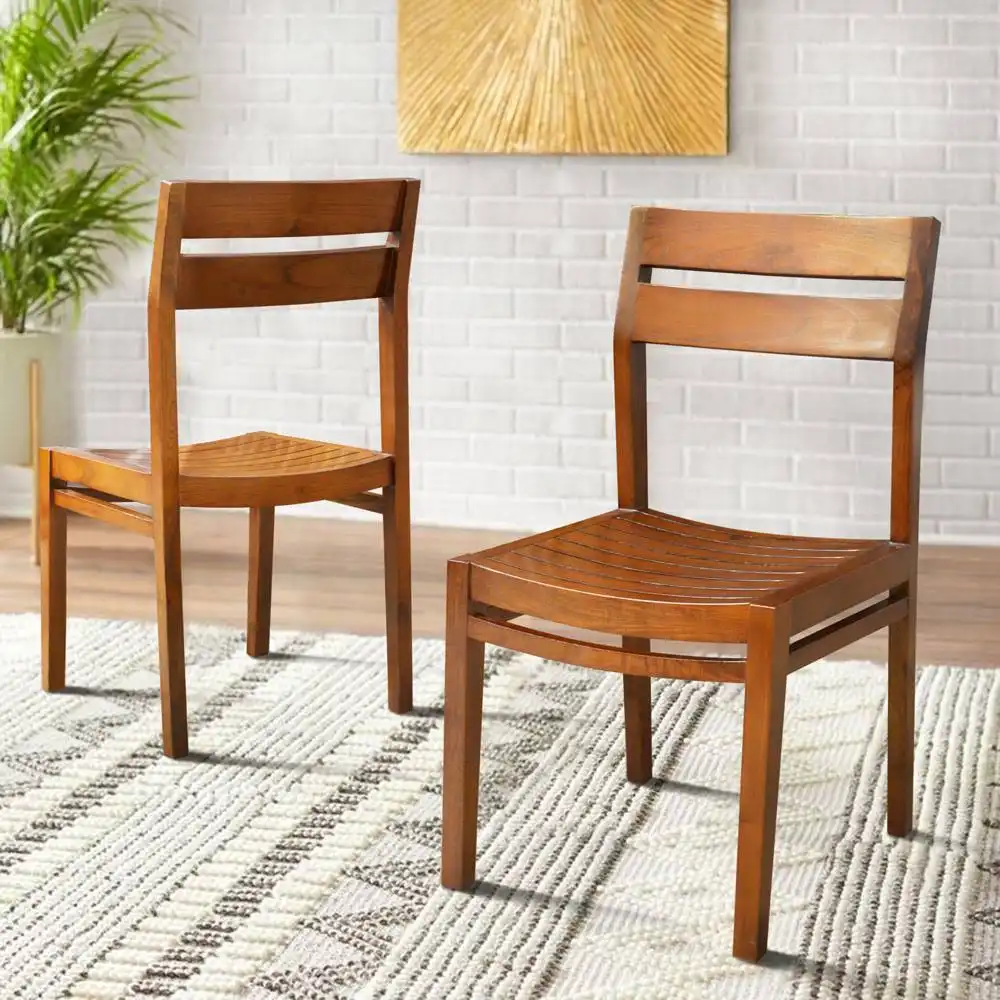
The Chair Restaurant Ubud is a seating unit constructed entirely from solid teak wood, intended for commercial dining environments and hospitality interiors. Teak is a dense tropical hardwood containing natural silica and rubber oils, which contribute to its resistance to moisture, decay, and insect infestation without requiring synthetic surface treatments. The visible grain structure on each chair displays tight, straight lines with a natural golden-brown hue that deepens into a rich patina upon prolonged exposure to ambient light and air.
The structural framework utilizes traditional mortise and tenon joinery, secured with wooden dowels to distribute weight evenly across the load-bearing joints. The front legs measure 45 centimeters in height from the floor to the seat panel, maintaining a standard vertical orientation. The rear legs extend upward at an ergonomic angle of 10 degrees to support the backrest assembly, terminating 85 centimeters above the floor level. Each leg tapers downward from a 45-millimeter square profile at the seat junction to a 30-millimeter footprint at the base, reducing overall visual mass while preserving structural integrity. Plastic floor glides are fitted into the bottom of each foot to prevent scratching on hard flooring surfaces and to minimize friction during movement.
The seat pan is constructed from solid teak planks, measuring 48 centimeters in width and 43 centimeters in depth. The upper surface of the seat features a shallow, concave depression routed into the wood by CNC machining, providing a contoured resting area for the user. The edges of the seat are hand-sanded to a uniform radius, removing sharp corners and providing a smooth tactile transition.
The backrest consists of two curved horizontal slats measuring 10 centimeters in height and 15 millimeters in thickness. These slats are steam-bent to match the natural curvature of the human spine, providing lumbar support during prolonged seated activities. The upper slat is positioned flush with the top rail of the chair frame, while the lower slat is spaced 5 centimeters below it, creating an open gap that maintains air circulation and light permeability through the dining space. The backrest uprights connect directly to the rear legs through internal tenons, locking the upper assembly rigidly to the lower frame.
Surface finishing involves a multi-step sanding process finishing at 240-grit smoothness, followed by the application of a clear matte water-based sealer. This sealer penetrates the pores of the teak wood to block liquid absorption and prevent staining from food or beverage spills, while preserving the matte, non-glossy appearance of raw timber. The coating is VOC-compliant and emits no harmful chemical odors once fully cured, making the chair suitable for enclosed restaurant interiors.
Weighing approximately 7.2 kilograms, the Chair Restaurant Ubud is lightweight enough for daily reconfiguration by service staff yet heavy enough to remain stable when sat upon. The design permits vertical stacking up to four units high, facilitating efficient floor clearance during cleaning operations. Maintenance requires only wiping down the wood surfaces with a damp cloth and mild neutral detergent; abrasive chemical cleaners or solvent-based polishes are unnecessary and discouraged. The hardware-free assembly relies entirely on wood-to-wood contact and structural adhesives rated for high-stress commercial applications, ensuring long-term durability under frequent restaurant usage conditions.
| Product Info | |||||||||||
|---|---|---|---|---|---|---|---|---|---|---|---|
| Dimension |
| ||||||||||
| Material | Teak | ||||||||||